 James Crawford
Key Takeaways
- Most current Samsung washers use a direct-drive motor and have no drive belt.
- On a belt-driven washer, a worn or broken belt is almost always worth replacing.
- A motor that hums while the drum stays still points at the belt on belt-driven models.
- A rough bearing or a belt that keeps failing is a bigger problem than the belt itself.
- Confirm the drive type from the model number before you decide.
The Bottom Line
Check the drive type first. On a belt-driven Samsung washer in good shape, a new belt is a sensible repair, and on a direct-drive washer the fault is somewhere else.
Before you ask whether a drive belt is worth replacing, check whether your Samsung washer has one. Most current Samsung washers use an inverter motor attached directly to the drum, with no belt at all, and our is it worth repairing a Samsung washer guide treats them that way. A belt appears only on belt-driven models, and there the answer is a clear yes more often than not.
| What you find | What it means | Repair verdict |
|---|---|---|
| Motor hums, drum does not turn, washer has a belt | The belt has snapped or slipped off | Worth it: a small, defined part |
| Drum turns but spins slowly or squeals | The belt is worn, glazed or stretched | Worth it on a sound washer |
| Direct-drive washer, drum does not turn | No belt: a motor, sensor or board fault | A different decision, see the motor guide |
| Belt keeps failing again and again | A pulley, bearing or alignment problem | Diagnose the cause before another belt |
Does Your Samsung Washer Have a Drive Belt?
Probably not if it is a recent front-load or top-load model, and yes on belt-driven machines. The drive belt connects the motor to the drum, and the site's not-spinning guide says that on belt-driven models a worn or broken belt leaves the drum motionless while the motor runs, whereas direct-drive units skip the belt entirely.
Do not guess from the outside. The model number tells you which design you own, and the use and care manual or a technician can confirm it in seconds. This matters because the repair, the cost and the verdict are completely different on the two designs.
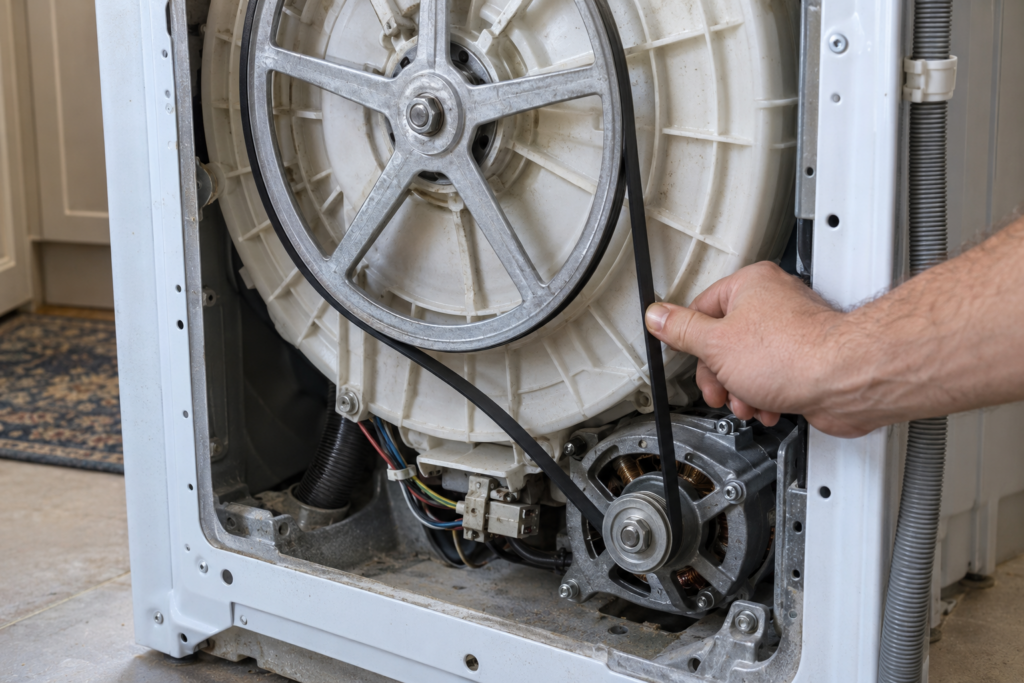
- Belt-driven: a belt loops around the motor pulley and the drum pulley, and wears like any rubber part.
- Direct-drive: the motor sits on the drum shaft and there is nothing to snap.
- Unsure: a diagnostic confirms the design and finds the real fault in one visit.
Is a Samsung Washer Drive Belt Worth Replacing?
Yes, on a belt-driven washer that is otherwise sound, because the belt is one of the cheapest and simplest parts in the machine. Our worth-repairing guide puts drive belts, drain pumps and door latches in the group that is almost always worth fixing, since the parts are inexpensive and the swap is quick.
- Replace it when the washer is sound. A belt that has worn out after years of use is normal wear, not a sign of a dying machine.
- Replace it when the drum and bearing feel smooth. A drum that turns freely by hand with the belt off is a good sign for the rest.
- Think again when the bearing is noisy. A rumble or a rough drum points at a bearing, which is a far bigger repair.
- Think again when the washer is very old. A new belt does not renew the seal, the pump or the board.
Age matters less for a belt than for a motor or a bearing, because the part is so small. A ten-year-old washer with a snapped belt and nothing else wrong is a normal repair, and a ten-year-old one with a belt, a leaking seal and a worn board is a different conversation.
How Age Changes the Answer
Our worth-repairing guide puts the life of a Samsung washer at roughly 8 to 12 years, and a belt repair fits comfortably inside that range. The part is small, so the question is less about the belt and more about the machine around it.
- Under about eight years: replace the belt without a second thought, because the rest of the washer has years left.
- Eight to twelve years: replace it if the drum, the bearing and the seal are all sound, and check them at the visit.
- Past twelve years: the belt is cheap, but compare the total of any other repairs the washer needs.
The single most useful fact is whether this is the first repair in years or the third in one. A first repair on a sound washer is easy to justify.
Signs the Belt Is Failing
A belt usually gives notice before it snaps, and the signs are worth acting on while the washer still works. They are the same on any belt-driven machine.
- Slow or weak spin. A stretched belt slips on the pulley, so clothes come out wetter than they used to.
- A squeal at the start of the spin. A glazed belt rubs on the pulley as the drum accelerates.
- A burning rubber smell. A slipping belt heats up, and the smell is a reason to stop and check.
- A motor that runs without the drum moving. The belt has come off or broken, and nothing is connecting the two.
If the motor hums and the drum stays still, do not run more cycles, because a motor working against nothing, or against a jammed drum, wears for no reason.
Is It the Belt, or Is It the Motor?
If the washer is belt-driven and the drum does not turn, the belt is the likely cause and the motor is the next suspect. A direct-drive washer has no belt, so a drum that does not turn there points at the motor, the hall sensor or the board.
The Samsung 3E code is a good example of the second case. Our 3E code page describes a motor or hall sensor fault, and our not-spinning guide ties 3E to direct-drive washers. Read our guide to repairing or replacing a Samsung washer motor if that is your situation.
Free Checks Before You Book
A few checks cost nothing and make the visit quicker. None of them involves opening the cabinet.
- Switch the washer off and turn the drum by hand. It should move with slight resistance and no grinding.
- Listen during a cycle. A motor hum without drum movement points at a belt or a coupling.
- Check the load. A drum packed too tight can slip a belt even when the belt is fine.
- Note the model number so the technician can confirm the drive type before the visit.
Write down what you hear and what the drum does. It narrows the cause and helps the right part come on the truck.
What a Technician Does at the Visit
The technician confirms the drive type, checks the belt for wear, slack or a break and spins the drum to feel for a rough bearing. If the belt is the cause, it is replaced and the pulley is checked at the same time, so you do not pay twice for a failure that has not been traced.
Our Samsung washer repair service covers belts, pumps, latches and motors. See what Samsung washer repairs cost if the price is the open question, then book a visit or send us the model number and what the drum does.