 James Crawford
Key Takeaways
- We found no Samsung clothes dryer recall on the CPSC list in October 2026.
- Samsung campaigns on the list cover washers, slide-in ranges and microwaves.
- Check by the model and serial on the rating plate, and trust only notices with a recall number.
- Lint buildup and blocked vents, not a brand defect, are the main reasons dryers catch fire.
- A burning smell, an hE code or a very hot exterior mean stop, whatever the recall list says.
The Bottom Line
Search the CPSC list with your model and serial number, and treat any dryer recall claim without a recall number as a rumor. Clean the lint path and stop at warning signs.
A Samsung dryer recall check starts with one fact: when we searched the federal recall list kept by the Consumer Product Safety Commission in October 2026, we found no recall of a Samsung-brand clothes dryer. People ask about one often, but the campaigns Samsung has actually run on the federal list involve washers, ranges and a microwave. This guide shows what the list contains, how to check your own dryer and what to do about the real fire risk.
| Samsung product on the CPSC list | Year | Hazard named in the notice |
|---|---|---|
| Slide-in electric ranges | 2024 | Front-mounted knobs can be switched on by accident, a fire hazard |
| Top-load washing machines | 2022 | Can short-circuit and overheat, a fire hazard |
| Top-load washing machines | 2016 | The top can detach during use, an impact injury risk |
| Over-the-range microwaves | 2009 | A shock hazard in certain installations |
| Front-load washers, with Maytag | 2007 | Water leakage onto the thermal sensor connections, a fire hazard |
| Clothes dryers | none found | No Samsung dryer campaign on the list |
Where Should You Check for a Samsung Dryer Recall?
Check the CPSC recall list at cpsc.gov and the manufacturer's own product safety notices. Both are first-hand sources, and a page that mentions a dryer recall without a recall number, a date or a link to the notice is not a reason to act.
Samsung's own support site also lets you look up a product by its serial number, and our recall check guide lists it as the second place to check after the federal list. If the two disagree, trust the notice that carries a recall number and a date.
That caution is worth repeating, because pages about recalls are often written from a template. A real campaign has a number, a date, a list of model and serial ranges and a remedy, and anything without those is a rumor. If you want to be sure, search the list by brand and by the words dryer, washer or range, and read the notice itself.
- Find the rating plate on your dryer and photograph the model and serial number.
- Search the CPSC recall list for Samsung and for clothes dryers.
- If a notice appears, compare your numbers with the model and serial ranges it lists.
- Read the remedy and follow it, and keep a note of the recall number.
Where Is the Model and Serial Label on a Samsung Dryer?
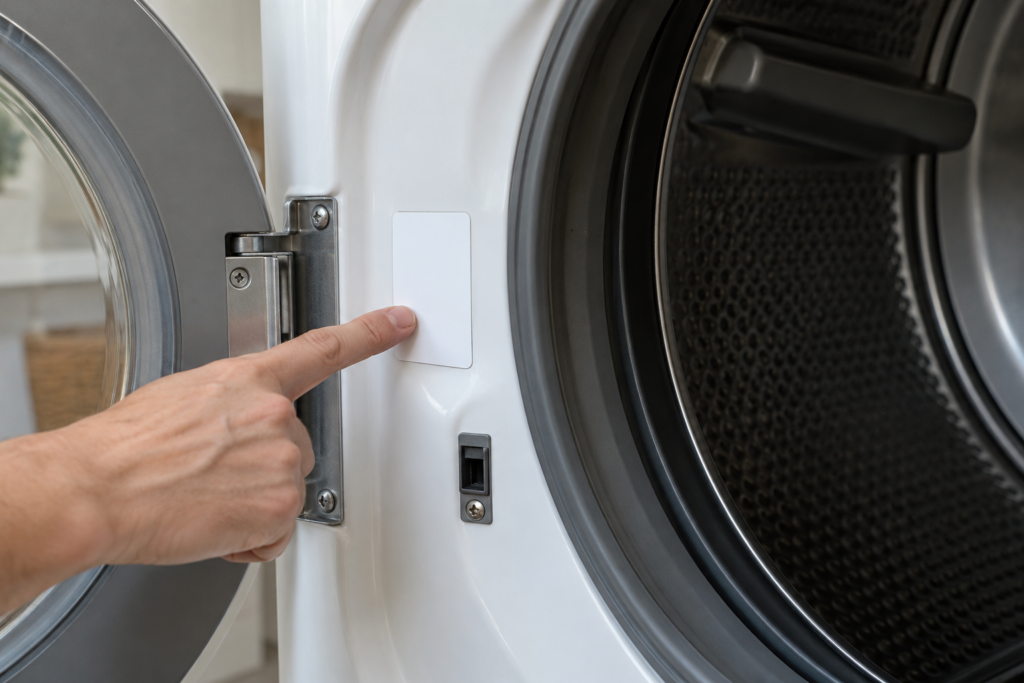
On most dryers the rating plate is on the door frame, visible when you open the door, or on the rear panel. Our Samsung recall check guide puts it inside the door opening or on the back panel for a dryer, and says to photograph it once.
Keep the photo with your receipt. The same two numbers serve a recall check, a warranty claim and any service call, and a dryer stacked above a washer is awkward to read twice. The date code inside the serial number matters, because a recall covers a range of dates, not a whole model line.
Are Samsung Dryer Fires a Recall Problem?
Not on the federal list. Lint buildup and blocked vents are widely reported as the main reason dryers catch fire, and that is a maintenance problem, not a defect in one brand. Our Samsung dryer lint fire prevention guide covers the routine.
- Clean the lint filter every load. A thin layer still restricts the airflow.
- Clear the vent duct every year. Use a brush kit or have it done as part of a visit.
- Use rigid metal duct. Foil and plastic ducts trap lint and can melt.
- Never run it while you are out or asleep. It is the simplest rule and the one that matters most.
How to Read a Recall Notice
A genuine notice has the same parts every time, and reading them in order tells you whether you are affected. The CPSC record gives a title, a date, a product description, the hazard and the remedy.
- The product description: names the brand, the product type and the model numbers included.
- The serial or date range: narrows the campaign to units built in a certain window.
- Where the label is: tells you where on the appliance to find the numbers.
- The hazard and the remedy: say what can go wrong and what the maker will do.
If one number does not match, read it again. A single digit in the wrong place is the difference between affected and not.
What the Real Samsung Campaigns Were
The campaigns on the list are specific, and each one tied to certain models. If you own a Samsung washer or range from those years, they are the ones to look up.
- Slide-in electric ranges, 2024: the remedy was a free set of knob locks or covers for the model, and a warning to check that knobs are off before leaving home.
- Top-load washers, 2022: the remedy was to check that the washer software was updated and to stop using the washer until it was.
- Top-load washers, 2016: the remedy was a free in-home repair that reinforced the washer top, or another option offered by Samsung.
- Front-load washers, 2007: a free repair was offered, and owners were told not to return the washer to the store.
None of these concerns a dryer. If you own one of those washers or ranges, the notice on the CPSC list tells you the model ranges and the remedy.
Warning Signs That Matter More Than a Recall
A dryer does not need to be recalled to be dangerous. These signs mean stop using it, whatever the recall list says.
- A burning smell. It can mean lint on the element or a failing part.
- Clothes that come out very hot. The dryer is overheating, often from poor airflow.
- The hE error code. Our Samsung dryer hE page covers a heating circuit failure.
- A hot exterior or scorch marks. Unplug the dryer and do not run it.
If the dryer shows any of these, a technician can test the heating circuit, the thermal protection and the airflow, and tell you whether the problem is lint, a part or the vent. A safe dryer is worth more than the loads you save by running it one more time.
What to Do if a Notice Does Match Your Appliance
Follow the remedy in the notice and stop using the part it names. Recall remedies are normally free, and doing the repair yourself or paying a third party can complicate the free fix.
- Stop using the named function. The notice says whether it is the whole appliance or one feature.
- Contact the maker through the notice. Use the route it gives, and keep the recall number.
- Keep your records. A photo of the plate and your receipt make any claim quicker.
For anything that is not a recall, our Samsung appliance recall check guide covers the wider routine, and Samsung dryer repair handles the faults. You can book a visit or tell us what the dryer is doing and we will help you decide whether it is safe to keep running.