 James Crawford
Key Takeaways
- 41E on a Samsung refrigerator means the freezer evaporator fan is not running correctly.
- The code page lists three causes: frost on the coils, a burned-out fan motor and a loose wire connector at the fan.
- Press the door switch and listen for the fan; silence means a manual defrost is the next step.
- Unplug for 24 to 48 hours with the doors slightly ajar, and move the food first.
- Do not remove panels yourself; call if the fan stays silent after a full defrost or frost returns within days.
The Bottom Line
41E is a freezer fan fault, often with frost involved. Test the fan with the door switch, do one full manual defrost and book a diagnostic if the fan is still silent or the frost returns.
A Samsung refrigerator 41E error tells you the freezer evaporator fan is not running correctly, and the first thing owners notice is a freezer that no longer holds its temperature. The Samsung 41E code page rates it high severity and puts frost on the evaporator coils first among the causes, with a burned-out fan motor and a loose wire connector behind it.
| What you see | What it usually means | What to do first |
|---|---|---|
| Freezer warmer than its set temperature | Fan is not moving cold air | Check the freezer thermometer |
| Thick frost on the back wall or evaporator cover | Frost is blocking or straining the fan | Plan a manual defrost |
| No fan hum when the door switch is pressed | Fan is not running at all | Listen again after a defrost |
| Ice cream soft, frozen food softening | Freezer has been above temperature | Sort food before it refreezes |
What Does the Samsung Refrigerator 41E Error Mean?
41E means the freezer evaporator fan is not circulating air, so the freezer cannot spread cold evenly. On French Door, 4-Door Flex and Side-by-Side models the page says the freezer fan runs independently from the refrigerator fan, so 41E hits the freezer first while the fridge section may seem normal for a while.
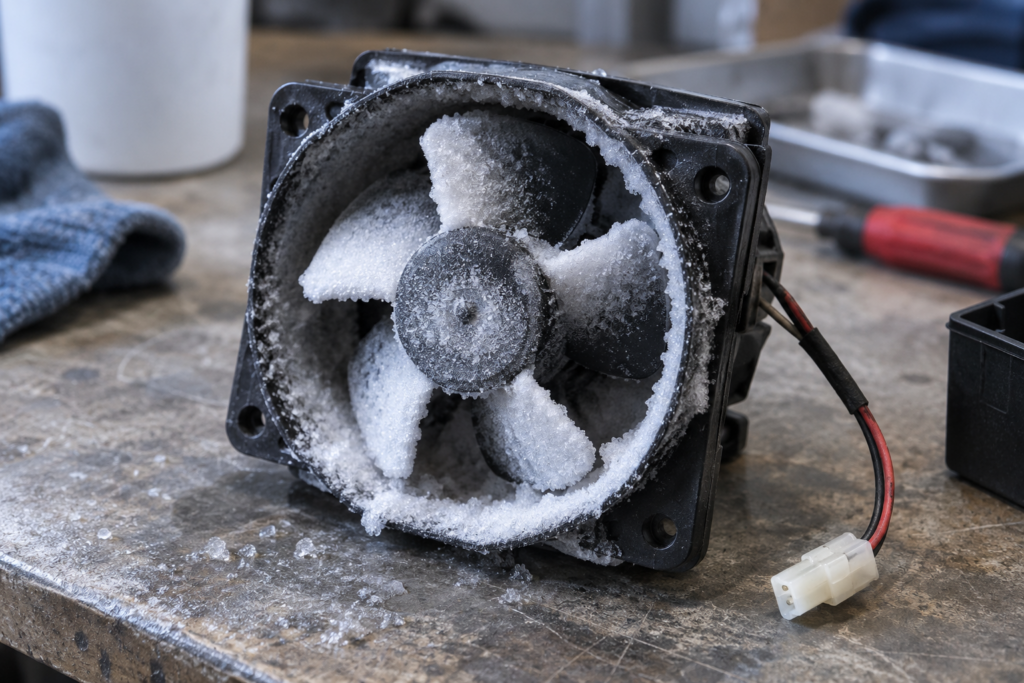
The fan matters because the freezer does not cool by sitting next to a cold surface. Air is pulled across the evaporator and pushed through the compartment. If the fan stops, the evaporator stays cold, the compartment does not, and the control board shows the code.
That also explains why 41E often comes with ice. A fan that has stopped lets frost build, and frost in turn stops a fan, so the two problems feed each other.
Is It Safe to Keep Using a Samsung Refrigerator With 41E?
Maybe, but only while you watch the freezer closely, because food is what is at risk. The code page says you can reset the code, and lists two stop signs: a fan motor that gives off a burning smell or a high-pitched whine, and damaged or frayed wiring behind the freezer evaporator panel.
- Freezer above 0°F. The page lists a freezer that cannot hold temperature as the first symptom, so frozen items begin to thaw or soften.
- Burning smell or whining. Unplug the refrigerator and keep it off.
- Visible damage to wiring. Do not touch it; this is a technician's job.
If the freezer is clearly warming, move the food into a cooler or a second freezer while you sort the cause. A fan fault is repairable, but thawed and refrozen food is not.
It also helps to know what the code does not say. 41E points at the freezer fan, so a refrigerator section that is only slightly warm is a knock-on effect and not a second fault. Treat the freezer as the patient first, and reassess the fridge once the freezer is cold again.
How Do I Test the Freezer Fan?
Open the freezer, press the door switch and listen for the fan behind the rear panel. The page says that on many Samsung models the fan stops when the door is open, so holding the switch in simulates a closed door, and silence from the fan means it is not operating.
- Open the freezer door and find the door switch; on some Samsung models it is on the top frame of the freezer opening.
- Press and hold the switch in to simulate a closed door.
- Listen for the low hum of the fan behind the rear panel.
- If it is silent, plan a manual defrost, because ice may be blocking the fan.
- After defrosting, test again before you decide the motor has failed.
The code page also describes removing the rear panel inside the freezer to look at the fan, but that is not something we would ask a homeowner to do. Leave panels and the fan housing for a technician.
Manual Defrost, Step by Step
A manual defrost clears ice that may be stalling the fan, and it is the one repair step the page recommends before a service call. It takes a long time, so start when you can see it through.
- Unplug the refrigerator. The page says to leave it unplugged for 24 to 48 hours with the freezer doors slightly ajar.
- Protect the floor. Put towels down to catch the meltwater.
- Move the food first. Frozen food cannot wait through a 24 to 48 hour defrost.
- Wipe dry and restart. Plug the refrigerator back in and listen for the fan with the door switch pressed.
The page says to call a technician if the fan is still silent after a complete 48-hour defrost, if frost returns within a few days, or if the fan motor looks scorched or the blades are cracked. Frost that returns quickly points to a defrost system fault, not only a fan fault.
Frost, Motor or Connector
The page names three causes, and they call for different repairs. A technician separates them by checking for ice first, then testing the motor and then the connector.
- Frost on the evaporator coils. A failed defrost heater, defrost thermostat or defrost timer lets ice build until it blocks or strains the fan.
- Burned-out fan motor. The windings or bearings have failed from age or strain, and the motor no longer spins the blades.
- Loose wiring connector at the fan. Compressor vibration can loosen the connector and interrupt power or the speed signal to the main board.
The first is the one to take seriously, because replacing a fan that is only a victim of ice will not hold. If frost keeps returning, the defrost parts are the real fault.
41E and the Neighbouring Fan Codes
Samsung uses nearby numbers for different fans, so check which code you have before you read further. The site lists the 40E and 39E pages separately and they describe different faults.
- 40E: the dedicated ice room fan on 4-Door Flex, Family Hub and certain Bespoke models. See the 40E code page.
- 39E: a general ice maker malfunction, covered in our Samsung 39E error code guide.
- 5E: a separate code with its own Samsung 5E error code guide.
If the refrigerator is warm and not only the freezer, our Samsung refrigerator not cooling guide covers the wider picture.
What a Visit Involves
The technician checks the evaporator for ice, tests the fan motor and inspects the connector, which separates the three causes. The diagnostic starts from $89, and the final price is confirmed after the on-site diagnosis, with a written estimate before any work begins.
Tell the technician three things when you book: how long the freezer has been warm, whether there is frost on the back wall, and whether the fan is silent with the door switch pressed. Those answers separate the frost, motor and connector causes before anyone arrives.
Our Samsung refrigerator repair service covers fan and defrost faults. Book a visit or contact us with your model, how long the freezer has been warm and whether frost came back after a defrost.