 James Crawford
Key Takeaways
- Clean the condenser coils about every six months, and more often with pets or dust.
- On most Samsung models the coils are at the back or underneath, behind a kick plate.
- Unplug the refrigerator, loosen the dust with a coil brush and vacuum it up.
- A compressor that runs almost constantly is a common sign of dirty coils.
- If cleaning does not help, a fan, a seal or the compressor may be the cause.
The Bottom Line
A coil brush and a vacuum used twice a year keep a Samsung refrigerator cooler, quieter and cheaper to run. If the compressor still never rests, book a check.
For Samsung refrigerator condenser coil cleaning, the plan is simple: every six months, unplug the refrigerator, remove the cover that hides the coils and clear the dust with a coil brush and a vacuum. Our Samsung refrigerator maintenance tips call it the highest-impact task on the whole list, because dust on the coils makes the compressor run longer to produce the same cold, and the compressor is the part that ages.
| Step | What to use | Why it matters |
|---|---|---|
| Unplug the refrigerator | Nothing, just the plug | Fan blades and wiring sit beside the coils |
| Remove the kick plate or rear cover | Your hands or a screwdriver, if the manual says so | Gives access to the coils |
| Loosen the dust | A long soft coil brush | Dust packs between the coil tubes |
| Remove the dust | A vacuum with a brush attachment | Stops it settling back into the room |
| Wipe and refit | A damp cloth | Clears the floor and the cover |
What Do the Condenser Coils Do?
The coils release the heat that the refrigerator pulled out of your food into the air of your kitchen. A clean coil sheds that heat easily, and a coil coated in dust and pet hair cannot, so the compressor keeps running to compensate.
You will not see the result in one day, but you will see it on the bill and in the lifespan. A refrigerator that runs longer uses more power, warms the kitchen and wears its compressor faster. That is why a clean twice a year is one of the best returns on any maintenance chore.
Where Are the Coils on a Samsung Refrigerator?
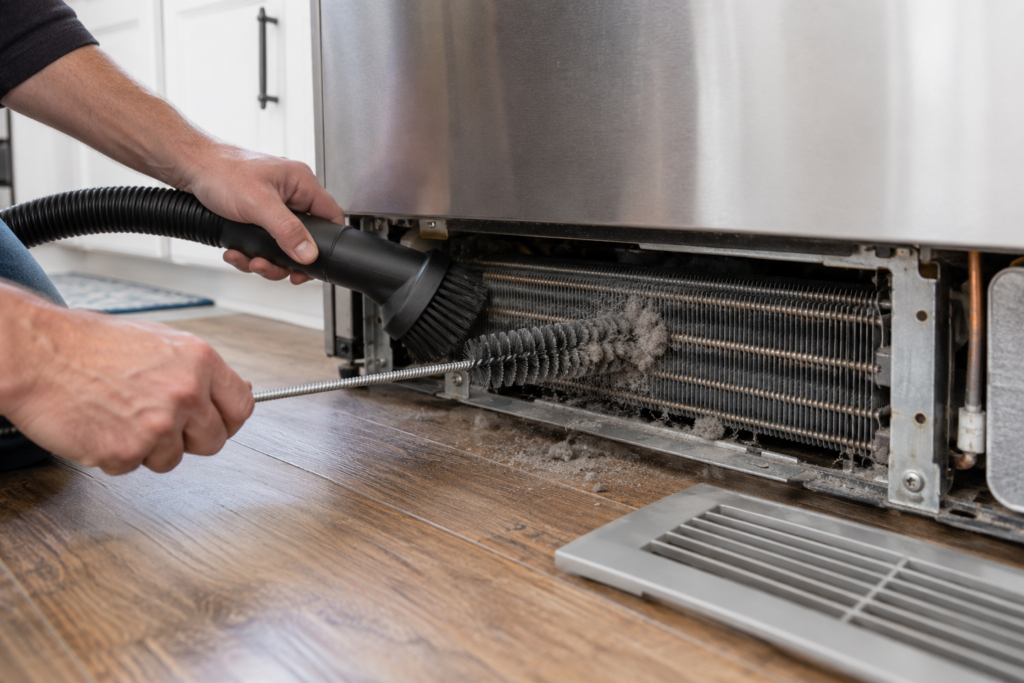
On most Samsung models the coils are at the back or underneath, behind a kick plate, according to our maintenance guide. Some refrigerators hide them behind a rear panel and others at the bottom front, so check the use and care manual for your model before you remove anything.
- Behind the front grille at the base: the most common spot, reached by lifting or unclipping the kick plate.
- At the back of the cabinet: reached by pulling the refrigerator out carefully, with a water line in mind.
- Not sure: the manual shows the location, and a technician can point it out during any visit.
If you have to pull the refrigerator out, do it slowly and straight, never by the door handles. Mind the water line to the ice maker and the water dispenser, since a kinked or pulled line is a far more expensive problem than a dusty coil. If the line has little slack, clean from the front through the base grille instead.
How Often Should You Clean the Condenser Coils?
Every six months is the interval our maintenance guide gives, and it fits most homes. Clean them more often if you have shedding pets, a dusty house, a kitchen with a lot of grease in the air or a refrigerator that sits in a tight alcove.
Pick two dates you will remember, such as the clock change in the spring and in the fall. A note on the calendar is worth more than good intentions, and the job is short once the cover is off.
The Cleaning Routine Step by Step
Take your time and keep the refrigerator unplugged throughout. Nothing here needs force, and force is how fins get bent and wires get pulled.
- Unplug the refrigerator and, if you must pull it out, protect the floor and mind the water line to the ice maker.
- Remove the kick plate or the rear cover, following the manual for your model.
- Run a long soft coil brush along the coils to loosen the dust, working gently in the direction of the fins.
- Vacuum up the loosened dust with a brush attachment, including the floor under the refrigerator.
- Wipe the cover, refit it, push the refrigerator back and plug it in.
Leave the doors closed for a few minutes while the compressor restarts. Do not expect a difference in temperature straight away, because the benefit builds over weeks of shorter run times.
After the clean, check the basics. Confirm the refrigerator is back to its usual running sound, and over the next day check that the fresh-food section holds a steady temperature. If the cabinet still drifts warm, the coils were not the whole story, and the not-cooling guide below is the next stop.
Signs the Coils Need Attention Sooner
You can often tell before the next date. These signs point to a refrigerator that is working harder than it should, and a dirty condenser is the cheapest cause to rule out.
- The compressor runs almost all the time. It cannot shed heat, so it never gets a break.
- The area at the base or the back feels very warm. Heat is not escaping into the room.
- The kitchen floor near the refrigerator is covered in dust. The coils are a source and a trap.
- The cabinet drifts warm. Our guide to a Samsung refrigerator not cooling lists the other causes.
Some refrigerators also run warm on their side walls in normal use, which is not a fault, so read the manual before you worry about it. Leave clear space around the cabinet as the manual asks, because a refrigerator pushed hard against a wall cannot shed heat either.
Clearance and Placement Around the Refrigerator
A refrigerator needs room to breathe. Even with spotless coils, a cabinet pushed against a wall or boxed into a tight alcove cannot shed heat, and the compressor works harder than it should. The manual for your model gives the clearances it wants at the back, the sides and the top.
- Leave the gap the manual asks for. Do not push the refrigerator flush against the wall.
- Keep the top clear. Boxes and baskets on top trap warm air.
- Keep it away from heat. A stove, a dishwasher or a sunny window next to it adds load.
- Do not block the base grille. Mats and rugs in front of it restrict airflow.
Good placement and clean coils work together. Either one alone leaves the compressor doing extra work.
When Cleaning Is Not Enough
If the compressor still runs constantly after a clean, or the cabinet will not hold temperature, the cause is elsewhere. A failing evaporator fan, a bad door seal or the compressor itself can all produce the same signs.
Keep a note of what you found. Heavy dust on a refrigerator cleaned only a year ago says the room is dusty, and a cleaner interval or a better location may be worth more than a better brush.
Our guides on whether a Samsung compressor is worth repairing and on compressor safety cover the next steps. Samsung refrigerator repair covers the fans, seals and sealed system, and you can book a visit or ask for preventive maintenance and have the coils done at the same time.