 James Crawford
Key Takeaways
- On Samsung refrigerators 39E is documented as an ice maker malfunction — the harvest cycle did not finish, which is a result rather than a named part.
- Frost in the ice compartment is the most common reason the code returns after a reset, because it blocks the ejector and buries the sensor.
- Neighboring codes separate the chain: 8E is the ice maker sensor, 40E the ice room fan, and 84C the wiring back to the main board.
- ICE-OFF is a setting, not a fault, and it gets toggled by accident more often than anything else on the panel.
- An ice maker can be switched off and the refrigerator used normally, which makes this repair a choice rather than an emergency.
The Bottom Line
Check the switch, the water supply, the filter, and the frost before pricing parts. If the code returns within weeks of a defrost, the compartment seal or the ice room fan is the real fault and the module is not.
Two characters on the door panel, no ice in the bin, and a search history full of contradictory answers. The Samsung 39E error code is one of the most looked-up faults on this brand, and most of the confusion comes from people reading it as a single part failure. It is not. It is the refrigerator saying the ice maker did not complete what it was asked to do, and there is a short list of reasons it would say that.
| Code on the panel | What this brand reports | Where it points |
|---|---|---|
| 39E | Ice maker malfunction | The ice maker did not finish its cycle |
| 8E | Ice maker sensor error | The sensor reporting the ice maker's state |
| 40E | Ice room fan error | Airflow into the ice compartment |
| 84C | Ice maker comm error | The wiring between module and main board |
| ICE-OFF | Ice maker turned off | Not a fault at all — a setting |
| FROST | Excessive frost buildup | Frost around the ice compartment |
What 39E Reports on This Brand
On Samsung equipment this code is documented as an ice maker malfunction, and the same two characters appear on the ice maker itself as 39E on the ice maker. That is the whole of what the appliance is claiming. It has asked the ice maker to run a harvest cycle, it has waited, and the expected result did not arrive.
What it does not tell you is which link in that chain broke. The module has a motor, a mold heater that releases the cubes, a fill valve upstream, and a wiring harness back to the main board. Any of them can produce the same two characters.
The Checks That Cost Nothing
Before anyone is called out, there are four things worth confirming, and each of them has genuinely been the whole answer for somebody.
- Is the ice maker switched on? The panel reports that state separately as ICE-OFF, and it gets toggled by accident more often than anyone admits.
- Is water reaching the fridge? Check that the supply valve behind the refrigerator is fully open and that the line is not crimped where the machine was pushed back.
- Is the bin seated properly? A bin pushed in crooked can leave the ejector arm blocked, and the module reports a cycle it could not finish.
- When was the water filter changed? A filter well past its interval slows the fill enough that the mold never fills to level.
- Is there visible frost around the module? That is a different story and the panel usually says so with FROST.
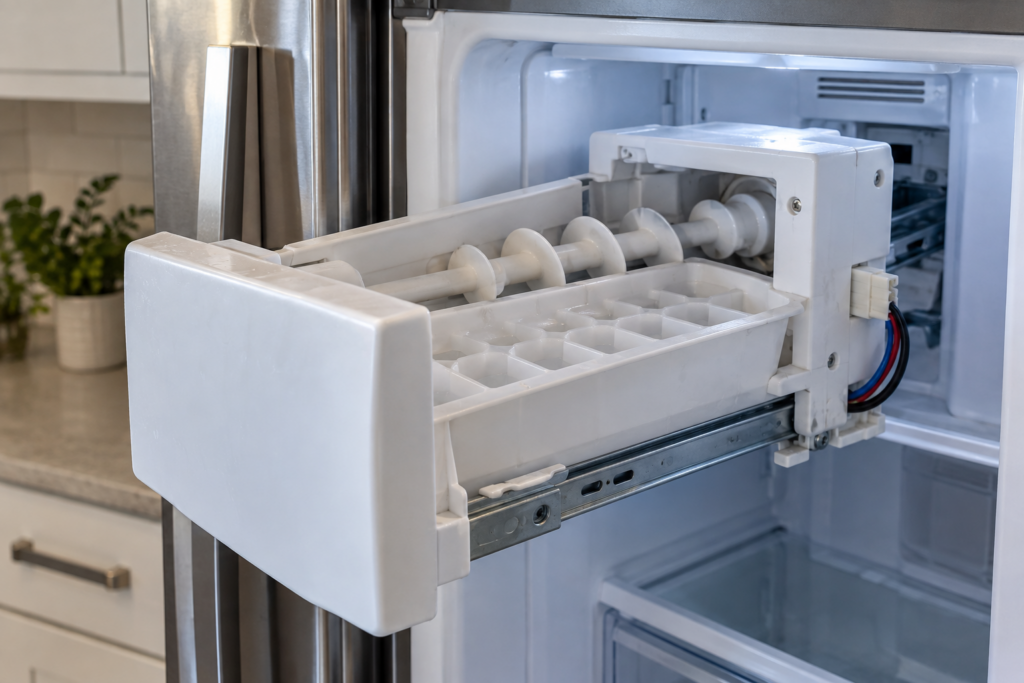
Frost, Airflow, and Why This Code Repeats
The single most common reason 39E comes back after a reset is frost. Ice makers in French-door refrigerators live in an insulated compartment with a seal around the door and a small fan moving cold air into it. When the seal is compromised, room air gets in, condenses, and freezes around the module.
Frost does two things. It packs around the ejector arm so the harvest cycle physically cannot complete, and it buries the sensor that tells the board what happened. That is why frost problems show up as an ice maker fault rather than a defrost fault, and why 40E, an ice room fan error is worth checking alongside it. A fan that has iced up stops moving air, and the compartment warms and refreezes on a loop.
A manual defrost of the compartment will usually clear the code for a while. If it returns within weeks, the seal or the airflow is the real fault and clearing the ice again will not change that.
When the Module Itself Has Failed
Once frost, water supply, and settings are ruled out, the remaining candidates are few and a technician can separate them in one visit.
- The ejector motor. The mold fills and freezes but the cubes never drop. This is the classic 39E with everything else healthy.
- The mold heater. Cubes freeze solid into the tray and will not release, so the harvest stalls every time.
- The sensor. Reported separately as 8E, an ice maker sensor error, but a drifting sensor can make the board give up on a cycle that was otherwise fine.
- The harness. Reported as 84C, an ice maker comm error when the board cannot talk to the module at all.
- The fill valve. Upstream of everything, and a partially failed valve gives short fills and half-formed cubes before it gives a code.
Ice maker module replacement starts from $249, and the final price is confirmed after the on-site diagnosis with a written estimate before any work begins.
Repair the Ice Maker or Live Without It
An ice maker is the one subsystem in a refrigerator you can switch off and keep using the appliance. That makes the decision different from a compressor or a sealed system fault, where there is no such option. Our Samsung ice maker repair or replace guide works through that comparison, and the Samsung refrigerator maintenance guide covers the filter and seal routine that keeps frost out in the first place.
Getting It Looked At
Ice maker work means pulling the module, checking the seal, and reading the board's own record of what the harvest cycle did — none of which is visible from the kitchen side of the door. Our Samsung ice maker repair service covers the module, the fill valve, and the compartment seal together, which is what stops the code from returning.
Diagnostic work starts from $89. You can book a visit or send us the model number and tell us whether the code came back after a defrost — that one detail narrows the job considerably.